Documented since 1371
History & Heritage
More than six centuries of history, from Gonçalo Lourenço de Gomide to Cardinal D. Luís de Sousa and the Dukes of Lafões — told from the archives.
More than 6 centuries
Six centuries of history
From the medieval couto to today’s estate, told from archive documents.
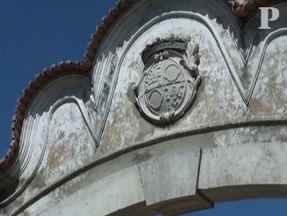
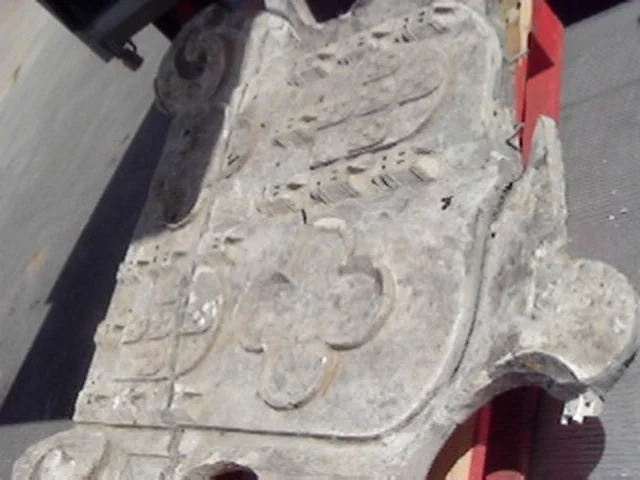
The 1857 Livro Tombo describes a wall seven feet high and 9 to 10 miles around, with three iron gates and a gateway bearing the arms of the House of Lafões.
1371 — 1411
The First Record and the Royal Grant
In 1371 a ruling by King Fernando names the «moradores de Alcoentrinho e Torre Bella», the oldest known mention of the place. In 1411 King João I grants the quinta of Torre Bela as a couto to Gonçalo Lourenço de Gomide, royal private secretary and great-grandfather of Afonso de Albuquerque, reserving to him the hunting, timber and grazing. The charter says the place «jazia acerca de hermo e dapnjficado» — lay almost deserted and ruined — and that Gonçalo Lourenço was restoring it. Before granting the charter the king sent his magistrate to hear the neighbours, and all agreed. Anyone hunting there without leave forfeited «a caça e as redes e os furões» — the game, the nets and the ferrets.
1413
The purchase of the Vale do Vasco
In Santarém, on 7 April 1413, Gonçalo Lourenço, the king’s private secretary, and his wife, Inês Leitoa, buy the whole of the Vale do Vasco from Afonso Anes da Barroca, of Alcoentre, for 3,000 libras, paid with a large silver basin and coin. The valley «borders on the said Torre Bella».
1470
The parish in 1470
On 3 September 1470 the convent of Almoster grants João do Outeiro and his wife, Eiria Gonçalves, a long lease on two plots at Outeiro da Arrifana. They bordered on land of Doctor João Pereira, on the heath and on the road from Cartaxo to São Pedro. The document does not mention Torre Bela, but it shows what the parish was like at the time (Torre do Tombo, Convent of Almoster, bundle 1, no. 60).
1495 — 1498
HighlightThe tower and lands of Torre Bella
On 27 July 1498, Jorge de Albuquerque’s attorney takes possession of the Vale do Vasco. The notary writes that he did so «within the tower and lands of Torre Bella», which D. Guiomar, Jorge de Albuquerque’s mother, had left him in her will. One of the witnesses is Fernão Afonso, «caseiro da Torre Bella» (tenant farmer of Torre Bella). It is the earliest evidence that the tower which gives the estate its name existed. The will of D. Guiomar de Sampaio, made in 1495, confirms that she was the widow of Pedro de Albuquerque and the mother of Jorge. The entail it creates covers only a quinta at Ribamar, so Torre Bela must have reached Jorge through another clause of the will or through a division of the estate (Torre do Tombo, Convento da Graça de Lisboa, book 1, fols. 62v–63v; Vinculum database).
1515
The first captain of Hormuz
Pedro de Albuquerque, son of Jorge de Albuquerque, was the first captain of Hormuz, in 1515. The Comentários of Afonso de Albuquerque describe him as «filho de Jorge, primo direito», the son of Jorge, first cousin of the governor. Jorge de Albuquerque was the son of Pedro de Albuquerque, known as «o Azeite», and of D. Guiomar de Sampaio, as her will of 1495 confirms. Pedro was the second son of João Gonçalves de Gomide and the uncle of Afonso de Albuquerque, Viceroy of India. Because Torre Bela was acquired in 1411, after the entailed estate of Vila Verde dos Francos had been founded (1398), it was not part of that entail and could probably pass to the younger branch of the family. Sources: Pedatura Lusitana; British Library, Lansdowne MS 189; A. Baião, «Alguns ascendentes de Albuquerque» (1915).
1540
The Albuquerques at Torre Bela
In 1540 the quinta belongs to D. Catarina de Almeida, wife of Jorge de Albuquerque, and is farmed by her grandson António de Albuquerque. A royal sentence of January that year orders him to pay the Crown the jugada tax on the grain he farmed at the «quintaã da torrebela» (Torre do Tombo, Gavetas, Gav. 10, mç. 2, no. 7). António was probably the natural son of Pedro de Albuquerque, the captain of Hormuz.
1586 — 1623
The Counts of Penaguião and the 1623 dowry
In 1586 João Rodrigues de Sá, Lord Chamberlain and 1st Count of Penaguião, holds the commandery of Alcoentrinho, next to the estate. In 1594 D. Luísa Henriques, widow of Sebastião de Sá e Meneses, appears as heir of a Pedro de Albuquerque, whom the catalogue does not identify (archive of the House of Aveiras e Vagos, box 89, bundle 25, no. 5). D. Luísa was the mother of João Rodrigues de Sá and so the mother-in-law of his wife, D. Isabel de Mendonça (Gayo, Nobiliário). If this Pedro is the one of Torre Bela, which is not proven, the quinta passed within one family, without a sale, until 1623. On 4 September 1623, now a widow, D. Isabel de Mendonça, Countess of Penaguião, gives her daughter D. Leonor de Mendonça, wife of the Count of Miranda, «the quinta of Torre Bela, in the district of Santarém» as part of her dowry, valued at one conto and six hundred thousand réis. D. Leonor is the mother of the future Cardinal D. Luís de Sousa.
1598 — 1661
The annexed lands of Alcoentre
Between 1598 and 1661 the lands of Cabarqueira, Motejo, Vale do Caldeirão and Vale de João Cabeças, in the district of Alcoentre, belong to residents of Alcoentre. They were probably later incorporated into Torre Bela. To the south, Cabarqueira bordered on the Quinta da Ferraria (Torre do Tombo, House of Lafões, NP 78, no. 6).
1603
The title deeds in the Countess’s keeping
In Porto, on 15 November 1603, the Countess of Penaguião asks for a certified copy of the deed of purchase of the Vale do Vasco; the original parchment was in her keeping. The Sá family therefore held the estate’s title deeds twenty years before the 1623 dowry.
1685
Cardinal D. Luís de Sousa
In his 1685 will, Cardinal D. Luís de Sousa, Archbishop of Lisbon, founds an entailed estate centred on his quinta of Torre Bela. He calls it «a quinta they call Torre Bela», where he has made «considerable improvements», and determines that it «shall give its name to the whole entail».
1686 — 1702
The wall of the estate
On 30 October 1686 the town council of Aveiras de Cima grants the Archbishop D. Luís de Sousa the sesmaria (land grant) of Charneca do Pinhão, marked out with six stone boundary markers. A few days earlier, on 13 October, the Archbishop was at Torre Bela, and from there he had ordered the lands bordering the quinta to be bought. In December 1687 he takes on lease from the Santarém town council two hills in the Vale dos Galegos «to straighten the said wall» of the «work he is carrying out on the Tapada of his quinta of Torre Bela», because «it is not right that for so limited a cause so great a work should remain imperfect». It is the oldest evidence of work on the estate wall. In 1699 he buys half of the Casal da Retorta. He dies in 1702.
1715 — 1718
The Dukedom of Lafões
The Cardinal’s heir is his brother, the Marquis of Arronches. Under the codicil of 27 December 1701, failing a male heir the entail passes to D. Luísa Casimira de Sousa, who in 1715 marries D. Miguel, natural son of King Pedro II. Their son, D. Pedro Henrique de Bragança, is made 1st Duke of Lafões in 1718. Torre Bela remains in the family for more than 250 years.
1728
The death of Cristóvão da Fonseca
The Jesuit and composer Cristóvão da Fonseca died «na Quinta da Torre-bella» on 19 May 1728, according to Barbosa Machado’s Bibliotheca Lusitana (vol. I, 1741).
1747
A park with three leagues of walls
In 1747 Father Luís Cardoso’s Diccionario Geografico describes the Duke of Lafões’s quinta as having «huma tapada, que consta de tres léguas de muros» — a park enclosed by three leagues of walls — with red deer, fallow deer and wild boar.
1752
The Ameixoeira fair
By a royal provision of 25 August 1752, King José I grants the Duke of Lafões an annual public fair on the last Sunday of August, next to the church of Nossa Senhora da Ameixoeira, «founded on lands of the said Duke belonging to his Quinta da Torre Bela». There was a pilgrimage, with people staying three days, stalls and leased houses. The Duke charged a ground fee: one tostão per square vara and per mount or head of cattle sold, and five réis per mount or head of cattle sold of sheep, goats or pigs.
1757 — 1773
The quinta in D. Joana’s letters
The letters of D. Joana Perpétua de Bragança to her brother D. João, the future 2nd Duke, describe life on the quinta between 1757 and 1773. In 1757 there are only «algumas obrasinhas de remendo» — a few small repairs — at Torre Bela. In 1761 D. Joana orders the rabbits to be culled, because tenants were leaving land untilled «for fear of this game», and writes that the olive groves «must be the main object». In January 1764, «a da Torre-Bella tem as medidas Mattheus Vicente» — the measurements of the Torre Bela plan are with Mattheus Vicente. In 1773 the steward Cipriano rebuilds houses and granaries, and the lake, made «larger and deeper», makes the quinta «more unhealthy in summer» (Lisbon Academy of Sciences).
1758 — 1781
The church left unfinished
In 1758 the parish survey (Memória Paroquial) of Arrifana singles out, among the quintas of the parish, that of Torre Bela, for «its great extent». That autumn the 1st Duke, already ill, goes to Torre Bela «com o gosto de principiar a Igreja que sempre desejou fazer» — with the pleasure of beginning the church he had always wished to build. The work is left unfinished, «in parts up to the cornice». In November 1781 the church is deconsecrated and the high altar demolished; the 2nd Duke intended to use the walls for houses (Lisbon Academy of Sciences, letter of 29 October 1758; Torre do Tombo, Memórias Paroquiais and House of Lafões, NP 76, no. 39).
1780
The visit of William Julius Mickle
In February 1780 the Scottish poet William Julius Mickle, translator of Os Lusíadas into English, was the guest of the 2nd Duke of Lafões at Torre Bela, where he had arrived with the Duke a few days earlier. In a letter to Thomas Caldecott, dated at Torre Bella on 5 February 1780, he called it «a beautiful and grand park» and recorded that they had discussed Robert Jephson’s tragedy Braganza (The Literary Panorama, 1809). Early that year, a letter about the founding of the Academy of Sciences says that the Duke «has gone to Torrebella, and from there goes on to Salvaterra» (Boletim da Segunda Classe, vol. 17).
1784
The survey of the estate
On 5 May 1784, Queen Maria I orders the chief magistrate of Santarém to measure, mark out and register the estate in a land survey (tombo), at the request of the Duke of Lafões. The whereabouts of that survey book are not known today.
1806 — 1927
The heirs of the House of Lafões
On the death of the 2nd Duke in 1806 the house passes to his daughter, D. Ana Maria de Bragança, and in 1851 to his granddaughter, D. Maria Carlota, wife of D. Pedro de Portugal e Castro. Entailed estates are abolished in 1863. D. Maria Carlota dies in 1865. In the 1868 partition, Torre Bela falls within the share reserved for the eldest son, D. Caetano Segismundo de Bragança, then aged 12, who holds it until his death in 1927 (Torre do Tombo, House of Lafões, NP 87, no. 6).
1846
The Patuleia
During the Patuleia civil war, Marshal Saldanha’s army was quartered at the «Quinta de Torre Bella» on 19 December, probably of 1846 (Montufar Barreiros, Os papeis de meu pae, 1904).
1853
Annexed farms and quit-rents
In 1853 Torre Bela includes neighbouring farms annexed to it, such as the Archino farm in Aveiras de Cima. Quit-rents were paid at the quinta itself, on 15 August.
1857
The Livro Tombo
The Livro Tombo (estate register) describes the whole quinta: the noble houses, the chapel of St John, the vaulted stable for 40 horses, the wine presses, the fountains, the gateway with the arms of the House of Lafões and the seven-foot wall, 9 to 10 miles around.
1866 — 1896
Bulls at Torre Bela
In the 1860s bullfights are held at Torre Bela, at the house of D. Pedro de Portugal e Castro, who had on the quinta «a ring where he tested the purity of the bulls». His son, D. Caetano de Bragança, fought as an amateur from 1870, and a source of 1896 mentions bull breeding on the estate (E. de Noronha, Estroinas e Estroinices; Gran diccionario taurómaco).
1873
The finest quinta in the parish
In Portugal Antigo e Moderno (1873), in the entry for Arrifana, Pinho Leal calls Torre Bela the finest quinta in the parish: a walled tapada of about 18 km, with deer and wild boar.
1875 — 1880
The Alviela aqueduct
On 31 December 1875, by amicable expropriation, D. Caetano cedes land on the quinta to the Lisbon Water Company for the Alviela canal (Torre do Tombo, House of Lafões, NP 76, no. 53). According to the press of 1880, the aqueduct tunnel, about 2,698 metres long, runs beneath the tapada.
1901
King Carlos’s deer
According to the Conde de Arnoso, writing in Sport in Europe (1901), the deer of the tapada were descended from animals given by King Carlos.
1925
The hunting park
On 10 March 1925 the Diário de Lisboa describes the tapada: a wall of about 18 km, iron gates, the bull pen and deer hunted with lances. The paper tells how D. Caetano Segismundo de Bragança, the owner of the estate, went hunting with his hounds across a vineyard his steward had planted in his absence, and said: «The tapada was made for hunting, and for hunting I want it.» The writer also describes the house: Portuguese eaves, two turrets at the corners and, in the dining room, «a huge chandelier made entirely of branching antlers».
1932
The fire in the tapada
In August 1932 there was a fire in the tapada. The press reported that «the palace of Torre Bella suffered no damage».
1946 — 1959
The estate in the mid-twentieth century
The ledgers for 1946 to 1949 show the estate in operation, with accounts for tiles and bricks, lime, brushwood, grapes, pigs and «Caça Real» (royal game) (Torre do Tombo, House of Lafões, books 166 and 167). In 1959 the Diário de Lisboa writes that in Portugal red deer live only in the Tapada de Mafra and at Torre Bela.
1965
The chapel in use
The Diário de Lisboa of 3 March 1965 shows that the palace chapel was still used for Mass.
1975 — 1976
The Carnation Revolution
On 23 April 1975, at the height of the revolutionary period, the estate is occupied by workers from neighbouring villages — an episode captured in Thomas Harlan’s documentary Torre Bela. By Ministerial Order no. 305/76 of 17 May, on the proposal of the IRA (Agrarian Reorganisation Institute), the property, of 1,436.78 ha, is expropriated from the heirs of D. Caetano Segismundo de Bragança. On 25 December 1975 a visitor is shown round the palace: two rooms were to be turned into a nursery school, and in the Duke’s former state room the remains of a party were being cleared away (Info Bug no. 90, Berlin).
1976 — 1985
Cooperative and State Management
The Torre Bela Agricultural Cooperative, formed in 1975, continues until about 1978. The estate then remains under State management and is returned to its owners in 1985; the expropriation order is only revoked in 1989.
1977
The attack on the cooperative
In September 1977 an armed group attacked the cooperative. They reached the wine cellar but not the palace, which then housed the cooperative’s offices. In December of that year the cooperative was called «23 de Abril» (Diário de Lisboa, 16 September and 16 December 1977).
1980
The fire of 1980
In September 1980 a large fire swept through the estate, at a time when the Ministry of Agriculture was preparing its return to the family (Diário de Lisboa, 11 September 1980). The estate was returned in 1985.
1985 — 1995
Soporcel and Portucel
Soporcel buys the core of the estate and leases the Tapada, in July 1986, and the Retorta, in August 1988, to plant eucalyptus on the burnt areas. In 1995 Soporcel, together with Portucel, plants about 40 hectares of vineyard.
1989
The forestry research centre
In June 1989 Soporcel opens a forestry research centre at Torre Bela (Diário de Lisboa, 27 June 1989).
1995 — 2023
The landscape from the air
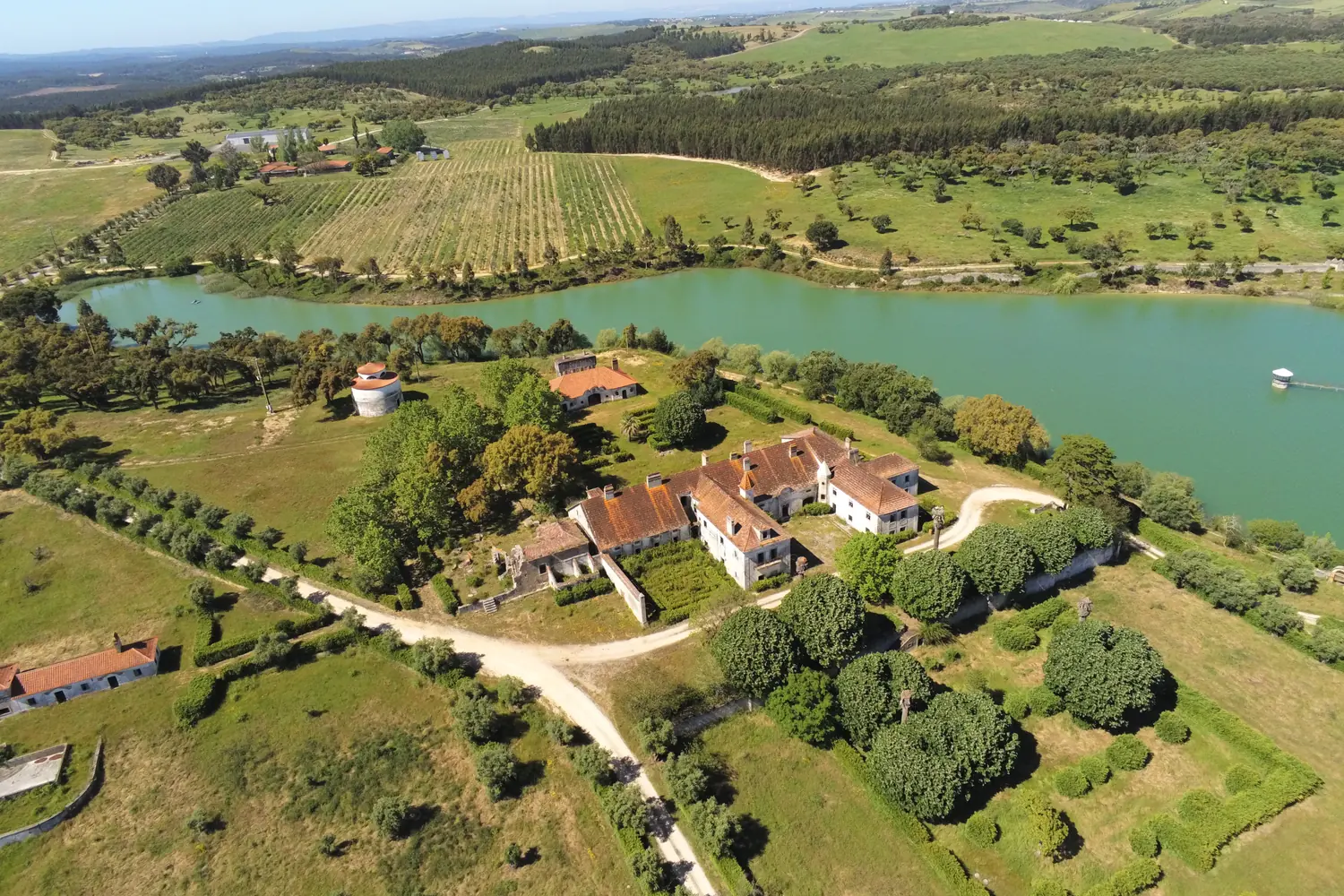
DGT orthophotos show that the formal gardens south of the palace, with the circular basin at the centre, the avenue and the olive grove, already had their present layout in 1995. The large reservoir north-east of the palace does not exist in 1995 and appears in 2004–2006: it was built between those dates. The palace roof is complete in 2004 and 2007; in 2023 it has gaps in several places, which indicates that it began to collapse after 2007 (DGT, orthophotos of 1995, 2004–2006, 2007 and 2023; 2024 LiDAR, 50 cm).
1997 — 2003
The Current Owners
In 1997 Sociedade Agrícola da Quinta do Convento da Visitação buys the Tapada and the Retorta and, in 2003, the rest of Torre Bela. It begins reintroducing red deer, fallow deer, roe deer and wild boar.
2008 — 2017
Forest certification and the modern olive grove
Forest certification is completed in 2008. The modern olive grove is planted between 2015 and 2017: today it has 1.2 million Arbequina and Arbosana olive trees.
2022 — 2025
The Solar Park
Land is leased to third parties for solar energy production, with an environmental impact study that preserved the existing cork oaks. The park begins producing in late 2024 and is inaugurated in June 2025.
From the Archive
What the documents say
The history of Torre Bela is being pieced together from archival sources — the Torre do Tombo National Archive, the National Library and the Lisbon Academy of Sciences. Some of the key documents:
King João I’s royal grant
King João I grants the «quintaa de torrebella» as a couto to Gonçalo Lourenço de Gomide, great-grandfather of Afonso de Albuquerque. The original entry survives in King João I’s chancery register.
The tower of Torre Bella
The title deeds of the Vale do Vasco: the 1413 purchase, the 1498 taking of possession «within the tower and lands of Torre Bella» and the copy requested in 1603 by the Countess of Penaguião. House of Abrantes, box 16, bundle 45, doc. 874.
The Cardinal’s will
D. Luís de Sousa founds an entailed estate centred on his quinta of Torre Bela, binding to it tapestries, silver and paintings.
The estate wall
The Cardinal leases land in the Vale dos Galegos to straighten the estate wall, «so great a work». House of Lafões, NP 77, no. 13.
The letters of D. Joana Perpétua
Thirteen letters from D. Joana Perpétua to her brother, the future 2nd Duke of Lafões, describe life on the quinta: stewards, livestock, game, olive groves and the church the 1st Duke wished to begin in 1758.
The Livro Tombo
Describes the whole estate: noble houses, chapel of St John, vaulted stable for 40 horses, wine presses, fountains and the wall.
The estate gate
A group photograph at a gate bearing the letters «TORRE BELLA» in iron, one of the oldest visual records of the estate.
The interiors on film
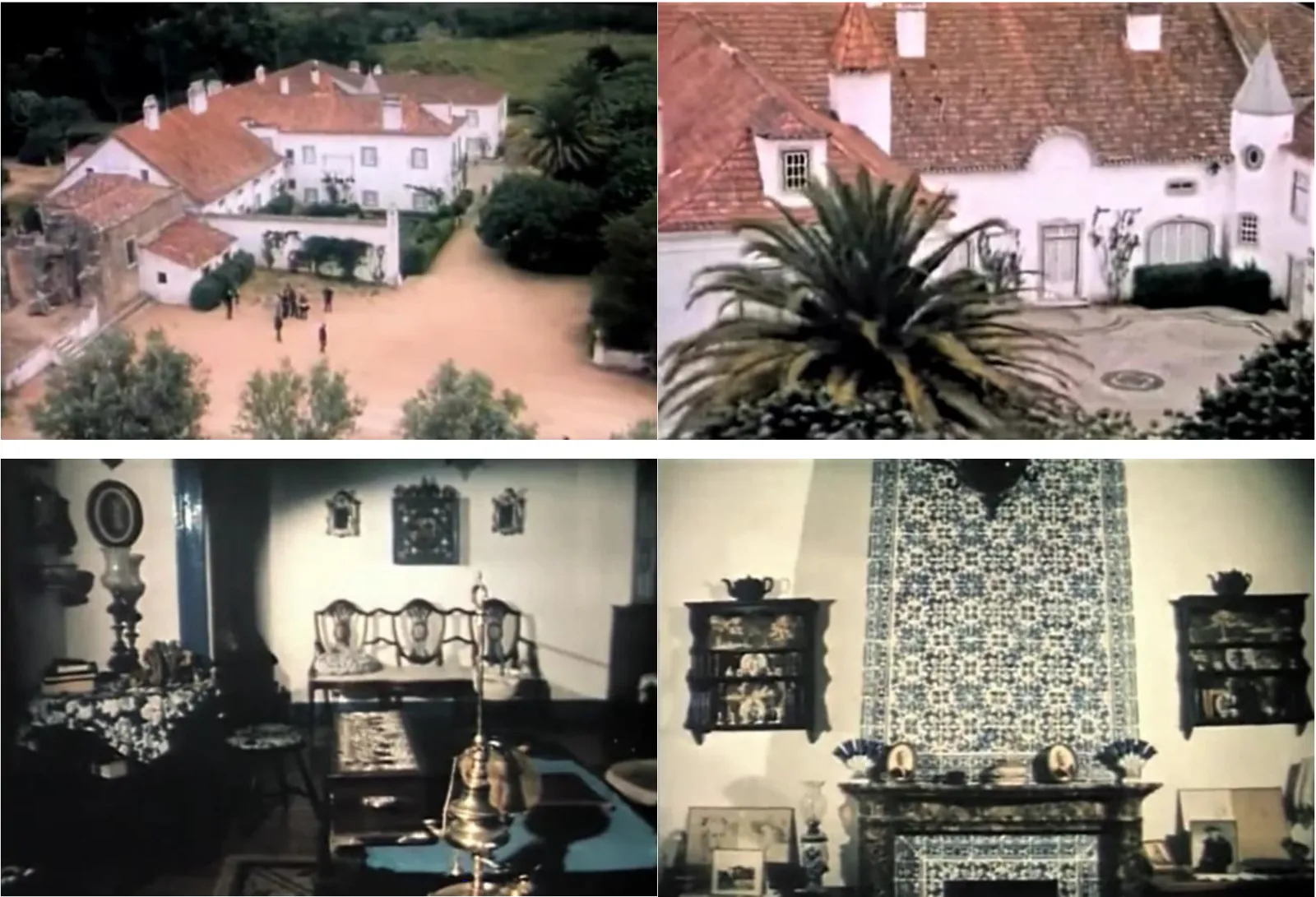
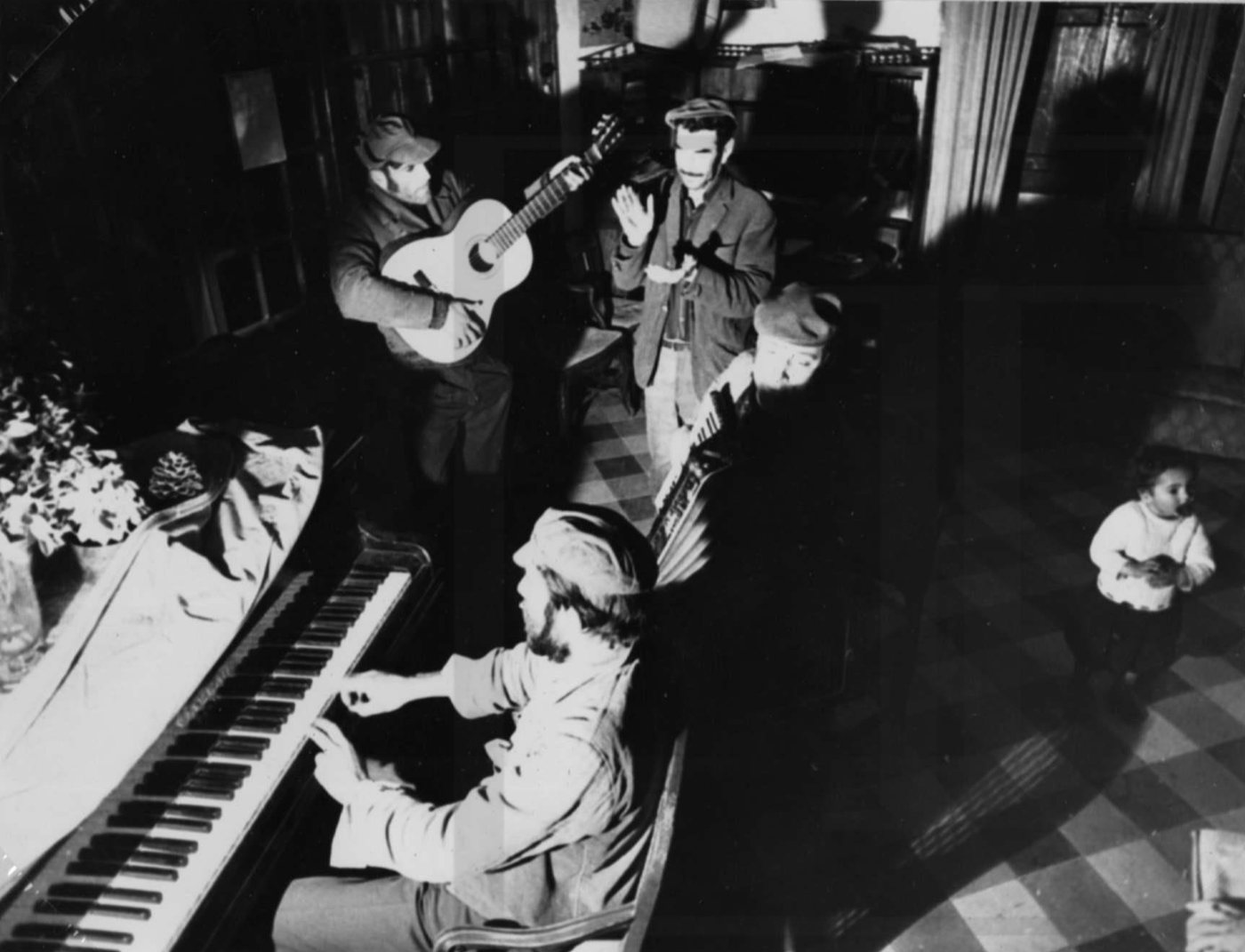
Footage by RTP and the documentary «Torre Bela» records the palace interiors in 1975.
What the family tells
Tradition says the Torre Bela wall was built with stone diverted from the works at Mafra — and that Mafra went to the legitimate son of King Pedro II and Torre Bela to his natural son.
What the archives say
The kinship is true: King João V and D. Miguel were half-brothers. But the Cardinal was already building the wall in 1687, work on Mafra only began in 1717 and the Mafra hunting park dates between 1757 and 1773. The manuscripts on the Mafra works read at the Torre do Tombo do not mention Torre Bela. Whether the church begun by the 1st Duke in 1758 used stone or masons from Mafra is still unknown — the research continues.
From the Archive
The Ameixoeira sanctuary
The church of Nossa Senhora da Ameixoeira was an old sanctuary, attached to the parish of São Pedro de Alenquer. The 1758 parish report describes it as a «fine rebuilt temple» with a single nave, tiled walls, a carved gilt-wood tribune and lodgings for pilgrims. From 1752 the annual fair on the last Sunday of August was held beside it.
It is not the unfinished church next to the palace, deconsecrated in 1781. They are two different buildings.
According to Pinho Leal, the image of Our Lady was later taken to the parish church of Abrigada. This has not yet been confirmed in archival documents.
Sources: Chancery of King José I, book 65, fol. 3 (Torre do Tombo); 1758 parish report.
From the Archive
The palace in 1956
In August 1956 the firm Leiria & Nascimento appraises the palace furniture: 24 rooms and 255 entries, for a total of 276,386 escudos. The appraisal goes through the house room by room: the Great Hall, the Camarata and its anteroom, the Blue Room, the Chapel, the main Entrance, the Dining Room, the Pantry, the Kitchen and fourteen bedrooms, among them the Tile Room. Among the items recorded are a «Noah’s Ark» attributed to Bassano, a suit of armour of Marco Barbarigo, engravings by Goya, the six Apostles of the chapel, a Senhor da Cana Verde (Christ with the reed) and a Gaveau piano in the Great Hall.
Source: Torre do Tombo, House of Lafões, NP 86, no. 29.
Photographic archive
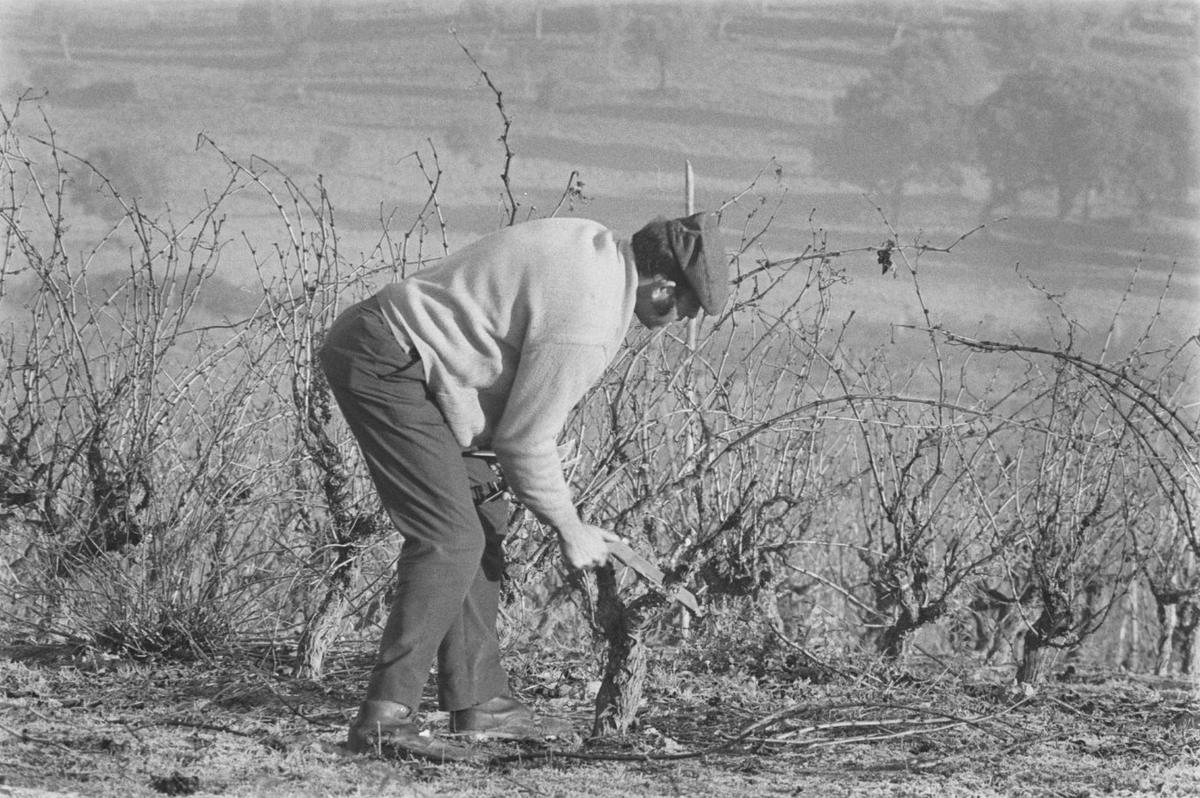
The cooperative in the fields
Photographs by Carlos Gil, probably taken in the winter of 1975–1976, show the cooperative’s workers pruning the vines, digging and working the vegetable garden.
YouTube Channel
Historical Videos
Documentaries and historical records of Herdade da Torre Bela.
The Occupation of Herdade da Torre Bela (1975)
Historical footage of the occupation of the estate on 23 April 1975, during the revolutionary period (PREC).
Agricultural Cooperative — Herdade da Torre Bela
Documentary on the Torre Bela Agricultural Cooperative in the post-revolutionary period.
“What is your tool worth?”
One of the best-known scenes from the cooperative period: the workers’ debate about sharing their tools.